Showing posts with label Central Java. Show all posts

Video Cave Tubing Goa Pindul, Wonosari - Gunung Kidul

http://touryogyakarta.com/wp-content/uploads/2013/03/Goa-Pindul3.jpg
yesterday, i'm and family explore Gunung Kidul, than we have visited Goa Pindul.

It's amazing scenery + funny Guide

link : https://www.youtube.com/watch?v=ZSnd-8HTF1E

Goa Jatijajar : Amazing Caves With Diorama In Depth - Kebumen, Central Java

Jatijajar cave is a natural tourist attractions such as caves located in the village Jatijajar, District father, Kebumen. The cave is formed of limestone. Jatijajar cave in length from the entrance to the exit along 250 meters. An average width of 15 meters and an average height of 12 meters, while the thickness of the ceiling average of 10 meters, and in height of 50 meters above sea level.

The cave was discovered by a farmer who owns the land above the cave Called "Jayamenawi". At one point Jayamenawi are taking grass, then fell kesebuah hole, it turns out that the hole is a ventilation hole in the ceiling of the cave. This hole has a center line and 4 meters high from the ground that are below 24 meters.


At first the doors Cave still covered by soil. So after the soil covering dismantled and disposed of, ketemulah doors are now to enter the cave. Because the front door of the Cave there are two large oak tree growing in parallel, the cave was named Cave Jatijajar

In the Jatijajar cave there are 7 (seven) river or spring, but that data is easily achieved with only four (4) rivers, namely:


     Puser river Earth
     river Jombor
     river Rose
     river kantil

To stream Jombor Puser Earth and the water is said to have properties can be used for all sorts of purposes in accordance with their respective beliefs. Meanwhile, if the water is said to Rose River to bathe or wash the face, can have properties ageless. The Spring magnolia if the water is to wash your face or shower, the intention / ideals will be easily achieved.


At the moment that have been built recently and Spring Spring Rose Kantil, while Spring and Spring Puser Jombor Earth unspoiled and still no light and slippery.
In 1975 Jatijajar cave was built and developed into attractions. As for who had the idea to develop or build Suparjo Jatijajar cave, Mr. Rustam as Governor of Central Java. Being at that time who became regent of Kebumen is Mr. Supeno Suryodiprojo.

To launch and implement development Jatijajar cave appointed directly by Mr. Rustam cv.AIS Suparjo of Yogyakarta, as head of cv.AIS is Mr. Saptoto, an artist famous deorama in Indonesia. Before the local government to implement pembagunan Kebumen Jatijajar cave, first local government Kebumen have compensating the affected population in the construction site Attractions: Covering an area of 5.5 hectares Jatijajar cave.

After Cave Jatijajar built then managed by the local government managers Kebumen. Since Cave Jatijajar built, in the Cave Jatijajar have added the art buildings include: installation of electric lamps as lighting, traps concrete to make it easy for tourists to get into the cave Jatijajar and the installation of statues or deorama.

Ambarawa Railways Museum - Ambarawa, Central Java


Ambarawa is famous nationwide by the credo Palagan Ambarawa. Small city that forgotten nowadays but became one of the important base camp of National heroes during Dutch occupancy in World War II. A small city in the junction of national road between Yogyakarta to Semarang and accessible to several small cities nearby like Salatiga, Magelang and Bandungan. Fifty km south of Semarang, Ambarawa has locomotives of various types and ages, and it is still possible to ride on a cog railway between Ambarawa and Bedono, a village nearby. Ambarawa Railway Museum 50 km south of Semarang, Ambarawa is the home of Java's antique locomotives, housed in a museum. Prior arrangements should be made for groups. Also of interest are a collection of antique telephones and other instrument used for railway communication.
The museum was established in the 1970s primarily to preserve a wide selection of the steam locomotives, which were then coming to the end of their useful lives on the 3ft 6in (1067mm) gauge railways of the Indonesian State Railway (the Perusahaan Negara Kereta Api, PNKA). These are parked in the open air next to the original station, originally a transhipment point between the 4ft 8 in gauge branch from Kedungjati to the northeast and the 3ft 6in gauge line onward towards Yogyakarta via Magelang to the south. It is still possible to see that the two sides of the station were built to accommodate different size trains. Ambarawa lays some way above sea level and was an administrative centre for the Dutch colonialists. Now the provincial Government of Central Java is increasingly taking an interest from the point of view of its heritage significance and its potential as a tourist attraction. Non-Governmental bodies like the Semarang Heritage Society are also acting to assist and there is also an unofficial overseas group 'The Friends of Ambarawa Railway Museum'.

Lawang Sewu: Beauty Behind The Mystical Arts - Semarang, Central Java


http://www.iberita.com/wp-content/uploads/2014/09/Lawang-Sewu.jpg review

Vacant buildings and tens or even hundreds of years old, tend to leave the mythical stories and haunted. Usually stories, history and condition of the building as the originator of awesomeness and mystical atmosphere in the building. Indonesia itself are considered to have a lot of old buildings that mystical yet historic and worth visiting. One is Lawang Sewu in Semarang, Central Java, which is the building of the Nederlands-Indische peningggalan Spoorweg Maatschappij or NIS. Built in 1904 was completed in 1907 and serves as an office. Located in Tugu Muda roundabout formerly called Wilhelmina Plein.


Lawang Sewu in Indonesian means "a thousand doors". The fact is no two-story building has a thousand doors. This building has a lot of high and wide windows on both wings, so people often think of it as the doors. In the building itself there are several rooms spread over two floors.

According to historical records, the old building was once the site of a bloody battle between youth AMKA (Young Generation Railways) against Kempeitai and Kidobutai Japan. This battle known as the Battle of Five Days in

Semarang which took place on 14-19 October 1945. Because of this historical value, then the government makes Lawang Sewu Semarang city as ancient buildings that should be protected.

Currently, the building was occasionally used as a page of a big show, and according to the news will never be used as a hotel. Because the location is haunted, film maker make this building as a shooting location with the same title and the theme of a horror movie.

activity


When entering into the room, you should familiarize yourself with the conditions of the room is dimly lit and stuffy and perhaps this is one of the factors that make the atmosphere in the room was tense. Apart from the ambience mystical, this building is very artistic and beautiful. You can see the colorful stained glass accents unique works of art are remarkable. Of all the rooms in the building, the only one that can be opened. The room is a room that is believed to function as a working space formerly high-ranking officials Netherlands. Can be seen from the existing facilities such as bathrooms that blend with the room and a balcony overlooking the Tugu Muda.

According to the testimony of some of the visitors, they had witnessed a strange figure appeared. If you are big balls and want to prove it, you can come over at 23:00 pm because Watcher Lawang Sewu (guide) is ready to receive you for 24 hours.

Ancient Museum Sangiran - Central Java

One of the interesting sites in the regency is Sangiran Museum located in the Sangiran Dome of the region. The dome is located in Depression Solo, at the foot of Mount Lawu (approximately 17 km from the city of Solo).


The presence of Sangiran is an example picture of past human life because this site is the site of the most complete hominid fossils in Java. The extent of 56 km2 which includes three districts in the regency, the District Gemolong, Kalijambe, and Plupuh, as well as the districts in Karanganyar, the District Gondangrejo.


Sangiran is an important site for the development of various fields of science, especially for research in the fields of anthropology, archeology, biology, paleoanthropology, geology, and of course to the field of tourism. The existence of Sangiran site is very useful for studying prehistoric human life because this site is equipped with ancient human fossils, the results of early human culture, flora and fauna fossils and their ancient stratigrafinya picture.

Sangiran bypassed by a very beautiful river, which empties into the Kali Cemoro the Bengawan Solo. This area is eroded soil so that the soil layer formed are markedly different between the soil layer with another layer of soil. In the layers of this soil, which until now are found fossils of ancient humans and animals.

Some early human fossils preserved in the Museum of Geology, Bandung, and Paleoanthropology Laboratory, Yogyakarta. Judging from the findings, Sangiran is a prehistoric site that has a very important role in understanding the process of human evolution and is the most complete archaeological sites in Asia and the world.

Based on this, Sangiran site designated as a World Heritage No. 593 by the World Heritage Committee during the 20th anniversary year in Merida, Mexico.


MINIATURE HMS Beagle
(SHIP DARWIN)

Research on early humans and ancient animals preceded by GHRVon Koenigswald, a paleoanthropologist from Germany who worked on the Dutch government in London in the 1930s. He is a person who has contributed to train people to recognize Sangiran fossils and the correct way to treat the fossils were found. Research results are then collected at home Krikilan village chief, Mr Totomarsono, until 1975.

At that time many tourists who come to visit the place, then came the idea to build a museum. At first Sangiran Museum is built on a land area of 1,000 m2 located next to the Village Hall Krikilan. A representative museum was built in 1980 for considering the increasing number of fossils found and at the same time to serve the needs of the tourists will be a comfortable tour. The building area of 16 675 m2 to 750 m2 area of the museum.

The building style joglo and consist of exhibit space, hall, laboratory, library, audio-visual room (where the film about the life of prehistoric man), warehouse storage, rooms, toilets, parking areas, and commercial markets (especially selling handicrafts' philosopher's stone beautiful 'raw materials obtained from Kali Cemoro).

In Sangiran Museum continued to reform and building additions and support facilities to reinforce its presence as a world heritage which has an important role for the development of science and to create comfort for the tourists who visit this place. Sangiran Museum now has evolved into a magnificent museum with modern architecture.


REPLICA FOSSIL HUMAN

Sangiran Museum Collection
Here are some collections that are stored in the Museum Sangiran:

     Human fossils, among others, Australopithecus africanus (replica), Pithecanthropus mojokertensis (Pithecanthropus robustus) (replica), Homo soloensis (replica), Homo Neanderthal Europe (replica), Homo Neanderthal Asia (replica), and Homo sapiens.
     Fossil vertebrates, among others Elephas namadicus (elephant), Stegodon trigonocephalus (elephant), Mastodon sp (elephant), Bubalus palaeokarabau (buffalo), Felis palaeojavanica (tiger), Sus sp (pig), sondaicus Rhinoceros (Rhino), Bovidae (cow, bull), and Cervus sp (deer and sheep).
     Fossil marine and freshwater animals, among others Crocodillus sp (crocodiles), fish and crabs, shark teeth, Hippopotamus sp (hippopotamus), molluscs (class Pelecypoda and gastropods), sp Chelonia (turtles), and foraminifera.
     Rock, among others chert, chalcedony, meteorites, and diatoms.
     Stone artifacts, such as flakes and blades, planer and augers, rectangular axes, stone balls and ax-penetak perimbas.

Source: Brochure "Museum of Antiquities: Sangiran (Amazing Journey Back to the Past) '(Office of Tourism, Investment and Promotion, Government of the regency, Central Java)

address:
Archaeological Museum SANGIRAN
Krikilan Village, Kalijambe
Sragen
Central Java
pages:
http://sangiran.sragenkab.go.id/

Hours Visits:
Tuesday-Sunday 9:00 a.m. to 4:30 p.m.

tickets:
Domestic tourists Rp.3000.00
Foreign tourists Rp.7500.00

Gedong Songo Temple, Temple Altitude of About 1,200m Above Sea Level


 Ticket : Adults / 5 years and over: Rp 5,000 / person  

and Rp 25,000 / person for Foreign Tourists
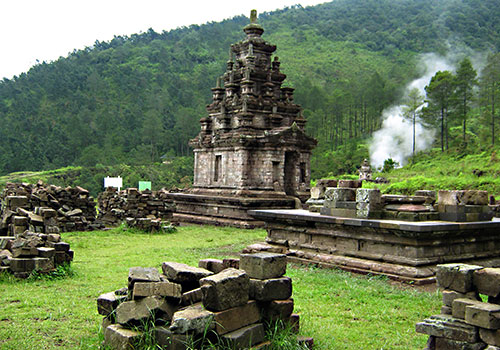
Gedong Songo is located on the slopes of Mount Ungaran, precisely in Gedongsongo temple, Hamlet Darum, Temple Village, District Bandungan, Semarang regency and the temple complex was built in the 9th century AD. Gedong Songo derived from the Javanese, "gedong" means a house or building, "Songo" means nine. So the meaning of the word Gedongsongo is nine (group) of the building.

Location 9 temples scattered on the slopes of Mount Ungaran has beautiful natural scenery. In the vicinity there is also a neat pine forests and springs that contain sulfur. Thin mist descends from the top of the mountain often appears resulted eyes can not look at Gedongsongo temple from a distance. This temple has similarities with Dieng temple complex in Wonosobo. This temple is situated at an altitude of about 1,200 m above sea level so the air temperature is quite cold here.

To go to Gedong I, we had to walk 200 meters through the path that goes up. You can use the services of a horse transport to travel around the sights Gedongsongo temple. In 1740, Løten find Gedong Songo complex. 1804, Raffles complex record with the name gedong Pitoe because only found seven groups of buildings. Van Braam make the publication in 1925, Friederich and Hoopermans writing about Gedong Songo in 1865. In 1908 Van Stein Callenfels terhadapt temple complex research and Knebel doing inventory in 1910-1911.

Sidelines between Gedong Gedong III with IV contained a mountain kepunden as a source of hot water with a high sulfur content enough. The tourists can shower and warm up disebuah baths built near the kepunden. The smell of sulfur is strong enough and a puff of smoke pretty thick when approaching the hot springs. Because beauty is Gedong Songo often be a wonderful place for a pre wedding photo photo.

To reach the required Gedong Songo travel about 40 minutes from the City Ambarawa with street riding, and the slope is very sharp. The location of the temple can also be reached within 10 minutes from the attractions Bandungan. Here's a list of the distance to this temple.


Rates Services Horse Riding Gedong Songo
- Tourism Village Rp 25,000 (Rp 35,000 Tourists)
- Into Hot Water Rp 40,000 (Rp 60,000 Tourists)
- Into Second Temple Rp 30,000 (Rp 40,000 Tourists)
- Package Songo temple Rp 50,000 (Rp 70,000 Tourists)

Bandungan and Gedong Songo Temple

- Ungaran – Gedong Songo : 25 km
- Ambarawa – Gedong Songo : 15 km
- Semarang – Gedong Songo : 45 km

Tickets : 
Adult / 5 years and over :  Rp.5,000 /person and Rp 25,000 / person for Foreign Tourists
This is a resort on the slope of mount Ungaran, about 900 meters above sea level. Gedong Songo (nine buildings), a group of small 8th century Hindu Javanese temples, can be reached either by car or on horseback from the town. Built at about the same time as the temples of the Dieng complex, Gedong Songo is one of the most beautifully sited temple complexes in Central Java and the views alone are worth the trip. Gedung Songo ('Nine Buildings') belong to the earliest antiquities of Java, they follow up the temples on the Dieng Plateau directly, for what about time. They were also built high in the mountains in an area full with volcanic activity; and they were also from Hinduist origin. But where the temples on Dieng Plateau are somewhat squeezed into a foggy valley, Gedung Songo are spread over the higher parts of the mountains, which guarantee a splendid view. On clear days, the horizon is one long row of volcanoes, from mount Lawu in the east, towards mount Sumbing, mount Sundoro and Dieng Plateau in the west.
The temples were built between 730 and 780, the first temple excepted, which could have been built some 30 years later. Gunung Songo is not the original name and also doesn't point at the number of structures. The number nine has a special meaning in the Javanese culture, in which there is a strong attachment to numbers. The temples are located at about the same distance from each other (100 meters, 200 meters) on a naturally formed terrace of edge of a mountain.

BOROBUDUR TEMPLE - AND AGENDA 200 YEARS OF DISCOVERY BOROBUDUR


http://www.borobudurpark.co.id/AppManual/inti/content/manualimageimage/event-new.png 
Opening Hours:
Monday - Sunday, at 06:00 - 17:00

Ticket Prices:
  • Indonesian local or KITAS card holder: IDR 30,000
  • Indonesian local children: IDR 12,500
  • Foreigner-Adult: USD 15
  • Foreigner-Student (registered): USD 8

Standing long before Angkor Wat in Cambodia and the great cathedrals in Europe, Borobudur Temple has stood gallantly in the land of Java. The building called by UNESCO as the most magnificent and the largest monument and stupa complex in the world is visited by pilgrims in the mid-ninth century until the beginning of the 11th century. Buddhist people who want to get enlightened were flocking from India, Cambodia, Tibet, and China. Not only magnificent and large, Borobudur Temple wall panels are filled with 2672 sculptured reliefs which if arranged in row, it will reach a length of 6 km! It is praised as the largest and the most complete Buddha reliefs ensemble in the world, unmatched in artistic value.
Reliefs carved on the temple walls are divided into 4 main stories, they are Karnawibangga, Lalita Wistara, Jataka and Awadana, and Gandawyuda. Besides telling about the life journey of Buddha and his teachings, reliefs alos recorded the improvement of Javanese community that was superior and powerful, and it can be seen in 10 reliefs of existing ships. One of the ship reliefs was used as a model in making ship replica used to sail the cinnamon route from Java to the continent of Africa. Currently, the replica of the ship called Borobudur Ship was kept in the Museum Samudra Raksa.
To follow the flow of the story carved on the walls of the temple, visitors must walk clockwise around the temple, known by the term of pradaksina. It is entering through the east entrance, walking clockwise to the position where the temple is always on the right side, until reaching the foot of the east stairs and stepping up to the next level. This is done repeatedly until all the levels passed and reached on the top of the temple shaping the main stupa. Arriving at the top, put your view in all directions, it will be seen a row of Menoreh Hill, Mount Sindoro, Mount Sumbing, Mount Merapi and Mount Merbabu standing up straight around the temple. Mountains and hills are as if guarding the existence of Borobudur Temple.
Based on Kayumwungan inscription dated 26the May 824, Borobudur Temple was built by King Samaratungga between the 8th until 9th century, coincided with Pawon and Mendut. The building process lasted for 75 years under the leadership of an architect, Gunadarma. Although not familiar with computers and other sophisticated equipments, Gunadarma was able to apply the interlock system in constructing the temple. As many as 60,000 cubic meters of andesite stone which amount to 2 million stone blocks compiled from Elo River and Progo River, they were carved and assembled into giant puzzles that covered a small hill to from Borobudur Temple.
Borobudur not only has a very high artistic value, a great work as the evidence of human civilization in the past is also loaded with philosophical values. Raises the concept of Mandala that symbolized the cosmology of the universe in Buddha teachings, this magnificent building is divided into three levels, namely the world of desire or lust (Kamadhatu), the world of form (Rupadhatu) and the world without any form (Arupadhatu). When viewed from the height, Borobudur Temple is like lotus petal on the hill. The wall of the temple which are in the Kamadhatu and Arupadhatu levels as the flower petals, while a row of circular stupa at Arupadhatu leves as the stamen. The main stupa represents the Buddha, so the whole Borobudur illustrates Buddha sitting on a lotus petal.
Enjoying the splendor of Borobudur Temple is no enough just walking down the aisle and climbing into the top of the temple. One thing to look out for is to see Borobudur Sunrise and Borobudur Sunset over the temple. The splash of morning sunlight hitting the stupas and the statue of Buddha makes the grandeur and splendor of the temple being more felt. While standing on the top of the temple at twilight within a row of stupas and watching the sun slowly began to shade will create a calm and peaceful feeling.
 
Support : Creating Website | Johny Template | Mas Template
Copyright © 2013. Magnificent of Indonesia - All Rights Reserved
Template Created by Creating Website Published by Mas Template
Proudly powered by Blogger